

NVIDIA is securing more than chips
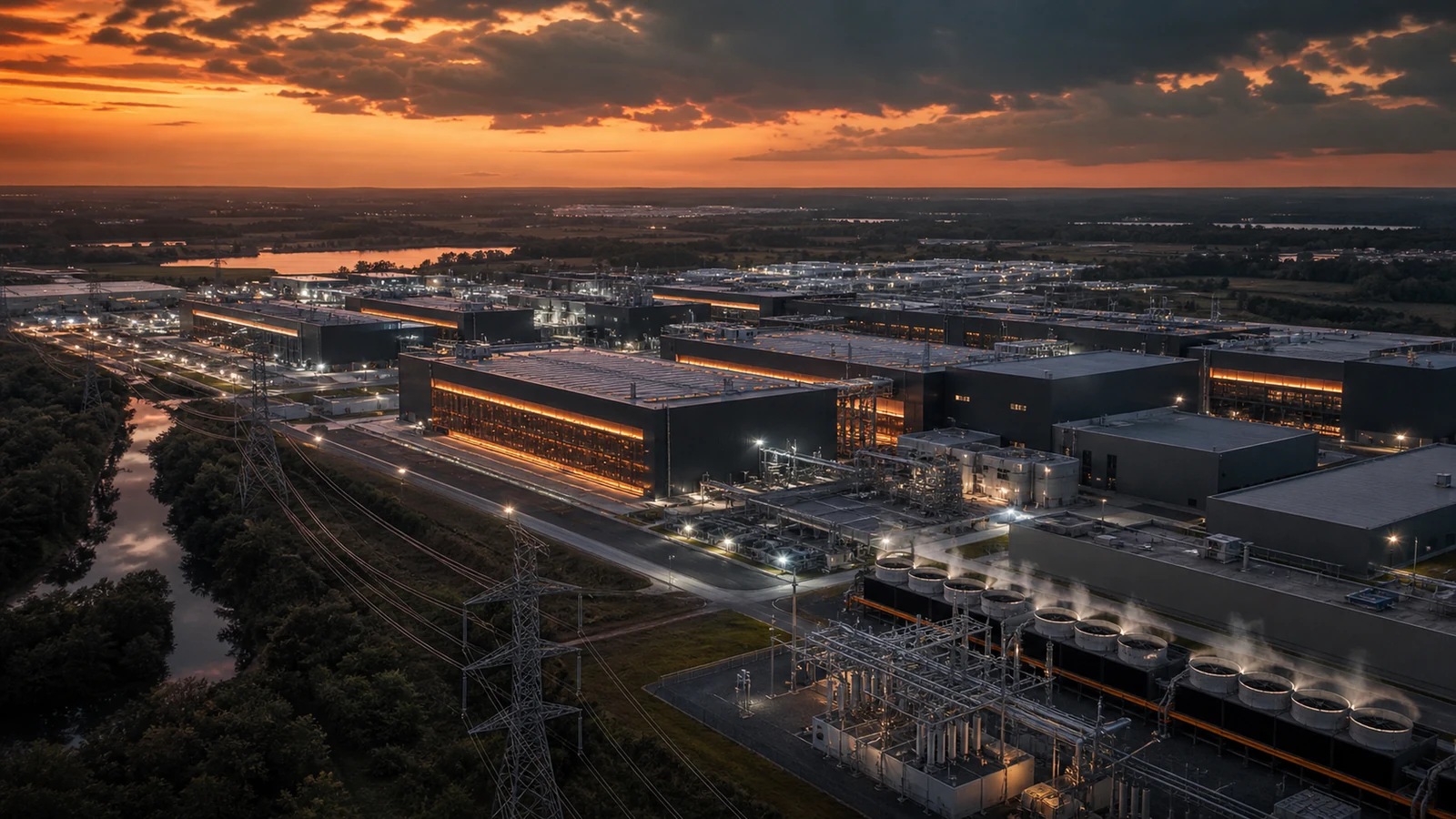
In an August 17 post, NVIDIA chief executive Jensen Huang said land, power, and data-center “shell” capacity have become strategic constraints for AI factories. NVIDIA is partnering with SB Energy to secure that capacity at the PORTS-Pike Technology Campus in Portsmouth, Ohio. OpenAI will be the tenant and will build and operate the AI factory.
The announced initial deployment is expected to provide 4.25 gigawatts of capacity using NVIDIA’s full-stack DSX platform, including processors, networking, and infrastructure software.
The commercial scale is unusually large
NVIDIA estimates that each generation of systems deployed at the site could represent about 1.5 million NVIDIA GPUs and roughly $150 billion to $200 billion in revenue. The site is intended to support multiple upgrade cycles over 20 years, so buildings and power infrastructure can remain while compute is replaced.
| Item | Figure |
|---|---|
| Initial PORTS-Pike capacity | 4.25 GW |
| Potential additional site capacity | 3.75 GW |
| OpenAI NVIDIA compute commitments through 2030 | About 12 GW, potentially about 16 GW |
| Support term | Approximately 20 years for about 4 GW |
What NVIDIA says it is guaranteeing
The company says its support covers defined portions of lease and power payments plus a specified residual-value commitment, not the full site cost or all tenant obligations. OpenAI will pay the lease. The guarantee is expected to become effective in phases as data centers enter service from 2028 through 2030.
NVIDIA argues that standardized compute can be reassigned to another qualified tenant if OpenAI does not use the site in the future. That is the company’s stated rationale; long-term demand, power pricing, construction, and tenant substitution remain execution risks.
Why this changes the AI supply story
AI competition is increasingly constrained by power delivery, financing, permits, construction, cooling, and grid connections. NVIDIA’s move applies supply-chain strategy to a layer it historically did not need to secure for most customers. Frontier labs can have strong product demand while lacking the balance sheet needed for multi-decade infrastructure contracts.
The announcement therefore links chip demand to project finance and energy infrastructure. It also increases the importance of deployment schedules: projected compute revenue depends on data centers and power arriving on time.
What remains uncertain
- The final construction and commissioning schedule.
- The exact financial exposure as phases enter service.
- Power sourcing, grid impacts, and operating costs.
- How quickly successive hardware generations are installed.
- Whether projected demand persists across the full term.
NVIDIA’s figures are company estimates and forward-looking expectations, not completed deployments. The immediate news is the strategic commitment to secure physical AI-factory capacity for OpenAI at an unprecedented stated scale.
Frequently asked questions
NVIDIA identifies the PORTS-Pike Technology Campus in Portsmouth, Ohio, with SB Energy as a partner and OpenAI as the tenant and operator.
NVIDIA says the initial deployment is expected to provide 4.25 gigawatts of AI-factory capacity.
No. NVIDIA says its support is limited to defined portions of lease and power payments plus a specified residual-value commitment, while OpenAI pays the lease.
Sources and references
- Securing the Infrastructure of IntelligenceNVIDIA · primary · Accessed 2026-08-20
- PORTS Technology CampusSB Energy · primary · Accessed 2026-08-20