

What “AI-native” should mean
An AI-enabled company buys tools. An AI-native company redesigns work around the capabilities and limits of those tools.
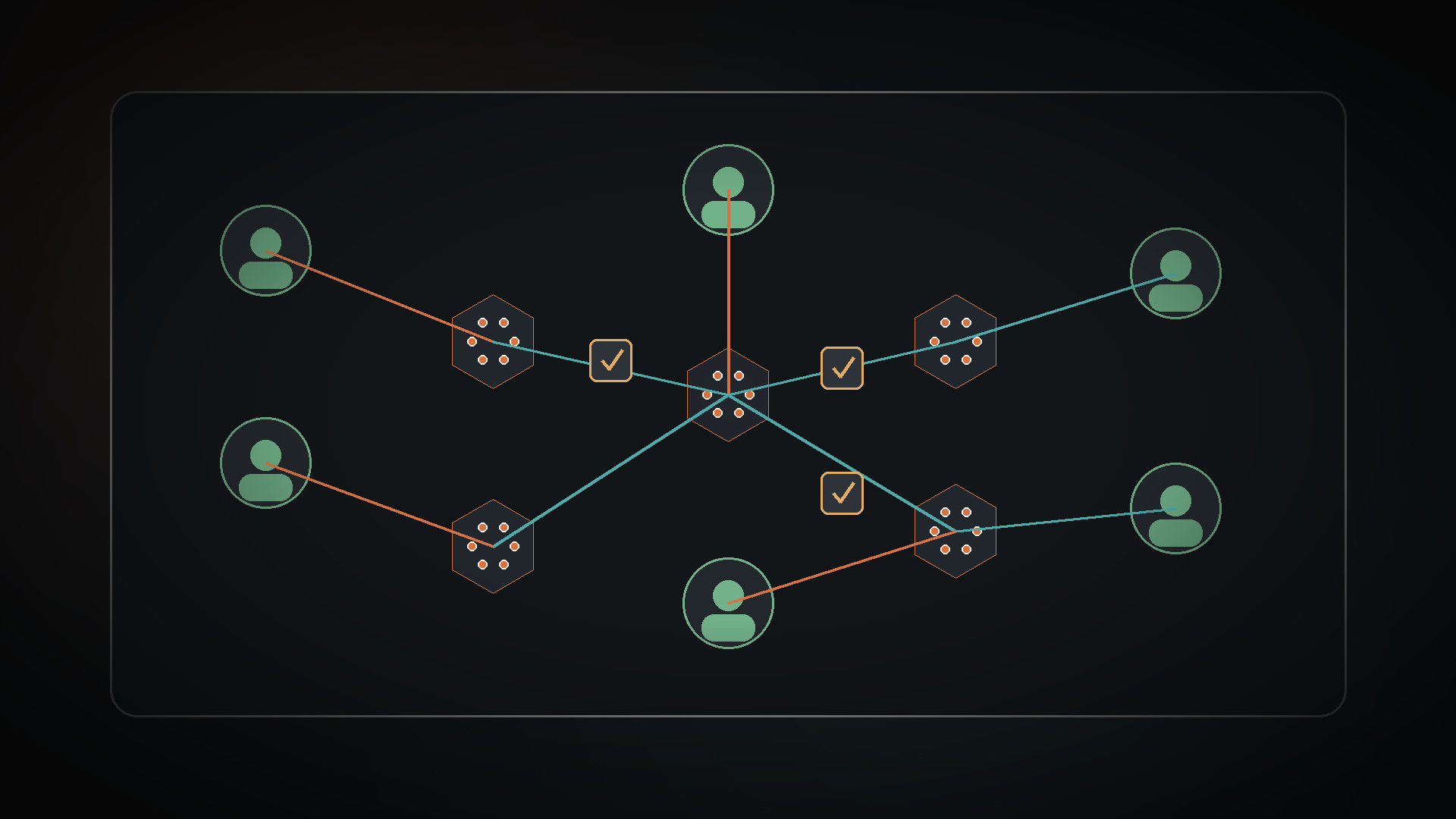
That redesign has six properties:
Processes have triggers, inputs, decisions, outputs, owners, and stop conditions that an agent can follow and a human can inspect.
Policies, product definitions, customer history, code, metrics, and examples are governed as common infrastructure rather than trapped in private chats.
Each agent has an identity, approved tools, narrow permissions, budget, memory scope, and escalation path.
Evaluation sets, review, outcome metrics, and incident data determine whether an agent is useful.
People own goals, judgment, exceptions, relationships, and consequential approvals even when agents perform much of the execution.
Automation reduces coordination load so specialists can work directly across functions instead of adding layers whose main job is relaying information.
This definition avoids two bad extremes. The first is “AI-native” as branding for ordinary software with a chat box. The second is the belief that autonomy removes the need for process. More capable agents increase the importance of permissions, evidence, and accountability because they can act across a wider surface.
What the evidence actually shows
Workplace AI has produced real gains, but the effects are uneven.
The Generative AI at Work study found a 14% average productivity increase among 5,179 customer-support agents, with a 34% increase for novice and lower-skilled workers and little effect for the most experienced. The system appears to have transferred patterns from stronger workers to those still learning.
In the BCG knowledge-worker experiment, participants completed more tasks, worked faster, and produced higher-rated results on work inside the model’s capability frontier. But the same research emphasized a jagged boundary: models can be excellent on one task and misleading on a nearby one.
A 2025 field experiment across 66 firms found that an integrated generative AI tool reduced email time and after-hours work, but individual access alone did not substantially change the quantity or composition of tasks. And METR’s developer study found a 19% slowdown for experienced open-source developers using early-2025 AI tools on their own repositories.
The evidence supports a sober claim: AI can compress learning curves, drafting, search, and routine execution when the task and context fit. It does not automatically redesign the company. Organizational change requires shared workflows, incentives, interfaces, and authority.
If an employee saves an hour but the next approval, handoff, or data bottleneck remains unchanged, the company may gain convenience without gaining throughput.
Four layers of agent adoption
| Layer | What the system does | Primary value | Main risk |
|---|---|---|---|
| Personal copilot | Drafts, summarizes, searches, explains, and assists one worker | Individual speed and learning | Private context, inconsistent quality, shadow usage |
| Shared specialist | Encodes a team’s approved workflow, examples, and knowledge | Consistency and scaled expertise | Stale instructions and unclear ownership |
| Workflow agent | Moves work across tools, gathers data, updates records, and requests approval | Reduced handoffs and cycle time | Overbroad permissions and silent action errors |
| Bounded autonomous worker | Runs long tasks, coordinates sub-agents, manages exceptions, and produces audited artifacts | Continuous execution and parallelism | Goal drift, compounding errors, high oversight demands |
Companies should not rush to the final layer. Maturity is earned by making the earlier layers reliable. A shared agent needs documented knowledge and an owner. A workflow agent needs identity, tool permissions, logs, and approval gates. A long-running worker needs evaluation, budgets, rollback, and a clear definition of completion.
OpenAI’s current workspace-agent materials emphasize the same operational controls: shared workflows, role-based access, approval checkpoints, audit logs, monitoring, and tool permissions. These are vendor claims about a product category, but they also reveal the practical boundary: agent capability becomes useful at scale only when the enterprise can constrain and observe it.
The operating model changes
The AI-native operating model moves from “people perform steps inside software” toward “people define and supervise systems that perform steps.” That changes the unit of design.
A person completes one step using a tool.
An agent carries context through multiple steps and systems.
A manager or procedure explains what to do.
Permissions, examples, tests, and approvals define acceptable behavior.
People resolve ambiguity, relationships, risk, and changes to the system itself.
Documentation stops being a static archive and becomes executable context. Definitions, policies, product rules, quality examples, and decision thresholds must be structured so agents and people can retrieve the same source of truth. Poor documentation, conflicting metrics, and ambiguous ownership become automation failures.
Meetings also change. Status collection can be automated from systems and agent logs. Human time shifts toward decisions, conflict, design, review, and problems not represented in the data. Companies that keep the old meeting structure while adding agents will simply generate more output to discuss.
Small teams without managerial layers
AI can support flatter organizations, but “no managers” must not mean “no ownership.” Coordination, coaching, priority setting, and conflict resolution still exist. The design question is whether those functions require a permanent hierarchy or can be distributed among accountable operators.
Jivaro’s operating philosophy favors small AI-assisted teams rather than managerial departments. A practical team might include an editorial operator, software engineer, product developer, support specialist, and business-development specialist who work directly from shared objectives and systems. One person may own an outcome or decision without becoming a layer whose primary function is supervising others.
Sets success criteria, constraints, budget, and priority.
Handles exceptions, standards, relationships, and quality.
Connects tools, maintains agents, and removes recurring friction.
Researches, drafts, transforms, routes, checks, or updates within permissions.
Validates evidence and accepts responsibility where stakes require it.
Turns failures and exceptions into better rules, examples, and tests.
These are functions, not necessarily six people. The same person can hold several roles in a small team, but the responsibilities must be visible. Flatness works when decisions are clear; it fails when nobody knows who can say yes, stop the work, or change the process.
Context becomes infrastructure
Agents need more than documents. They need a semantic map of the company: what entities mean, where authoritative data lives, which policies apply, who owns each process, and how current information should override old examples.
Build context in layers:
- Stable foundation: company identity, product definitions, policies, terminology, legal constraints, and brand rules.
- Operational state: current projects, customers, inventory, tickets, metrics, schedules, and incidents.
- Workflow instructions: triggers, steps, tools, approval thresholds, and output formats.
- Quality evidence: accepted examples, rejected examples, rubrics, tests, and postmortems.
- Personal context: user preferences and temporary working memory, separated from shared policy.
Do not solve context by giving every agent unrestricted access to every system. Retrieval should follow identity and purpose. The agent that drafts a support reply may need the ticket and approved policy, not payroll records or the entire drive.
Permissions, approvals, and logs
An agent that can write a draft and an agent that can send the message are different risk classes. Treat tools as capabilities:
| Capability | Default control | Example |
|---|---|---|
| Read public or approved internal context | Automatic within role | Search policy and product documentation |
| Create a private draft or analysis | Automatic with logging | Draft a report or summarize tickets |
| Modify reversible internal state | Bounded permission and validation | Update a tagged CRM field |
| Communicate externally | Human approval until proven low-risk | Send customer email or publish content |
| Spend money, delete data, change access, or make regulated decisions | Named human approval and strong audit | Issue payment, terminate account, change permissions |
Logs should answer: what goal was assigned, which context was retrieved, what tools were called, what the agent changed, which model and workflow version ran, which checks passed, who approved the result, and how the outcome was measured.
Evaluation replaces vague trust
Companies often ask whether they “trust” an agent. Trust is too broad. Evaluate the agent on a defined task distribution and monitor the failure modes that matter.
- maintain representative and adversarial test cases;
- score correctness, completeness, policy compliance, provenance, format, and action safety;
- weight severe failures separately from cosmetic defects;
- measure review minutes and override rates;
- run tests after model, prompt, connector, policy, or data changes;
- compare against the human or deterministic baseline;
- use incidents and rejected outputs to expand the evaluation set.
Evaluation also creates organizational memory. Without it, the company relearns the same limitations whenever a model changes or a new team adopts the tool.
A 90-day transition plan
Identify repetitive workflows, critical decisions, existing automations, shadow AI use, and high-friction handoffs.
Select one personal-assistance case and one shared workflow with reviewable output.
Document the process, permissions, examples, evaluation set, and stop conditions.
Keep the existing process available while measuring output quality, review time, and downstream results.
Remove meetings, copying, and approvals made redundant by reliable system evidence.
Expand only where metrics improve. Document failures, owners, and the next evaluation date.
Failure modes and counterarguments
“Agents will remove the need for expertise.”
Evidence suggests the opposite at the system level. Novices can gain more from assistance, but experts are needed to define standards, detect subtle failures, handle exceptions, and improve the workflow. Expertise shifts from performing every routine step to designing and validating the system.
“Every employee should build their own agents.”
Experimentation is useful, but unmanaged agents create duplicated work, inconsistent policy, uncontrolled permissions, and invisible dependencies. Shared agents should be treated as maintained internal products with owners and tests.
“Flat teams eliminate coordination.”
They eliminate some hierarchy, not the work of alignment. Goals, interfaces, ownership, and conflict resolution must become more explicit.
“More autonomy always means more leverage.”
Autonomy can compound both progress and error. Long-running agents require budgets, checkpoints, rollback, and escalation. A shorter verified workflow can outperform a nominally autonomous one.
“AI-native means replacing people quickly.”
Premature headcount reduction can remove the people who understand the workflow before it is encoded. The safer sequence is observe, assist, standardize, automate, then redesign capacity.
Jivaro forecast: 2026–2030
Organizations will move from private prompts toward maintained agents with approved context, tools, permissions, and owners.
Status collection and routine coordination will automate first; goal setting, coaching, conflict, and accountability will remain human functions but not always permanent hierarchy.
Each agent will need scoped credentials, audit logs, budgets, and a clear human sponsor.
Companies will maintain task-specific tests and incident feedback much as software teams maintain automated tests and observability.
Teams with clean systems and narrow products can operate across more functions without recreating large departmental structures.
Adoption data already show AI use concentrated in a limited number of business functions. Tool access will grow faster than workflow redesign.
Jivaro is organized around small AI-assisted teams and focused tools rather than managerial layers. The practical goal is not to automate judgment away, but to remove repeated mechanical work so operators can own outcomes directly.
Frequently asked questions
A company that redesigns workflows, context, permissions, evaluation, and team structure around AI capabilities and limits. It is more than a company that buys chatbots.
They will automate status collection, routing, reporting, and some coordination. Goal setting, coaching, conflict resolution, judgment, and accountability remain necessary, though they may be distributed without traditional managerial layers.
Personal agents can help, but organizations also need shared agents with approved context, permissions, maintenance, and evaluation. Private agents alone create fragmented systems.
Only the amount justified by tested reliability, reversibility, and risk. Drafting can be automatic; external communication, spending, deletion, access changes, and regulated decisions usually need stronger approval.
Work with digital inputs, repeated patterns, measurable outputs, and low-cost review changes first: support triage, research, reporting, coding assistance, document preparation, and operational routing.
Often, because it has fewer systems and approval layers. But small firms also have less capacity for security, evaluation, and maintenance, so narrow workflows and disciplined controls are essential.
Sources and references
- NBER: Generative AI at WorkNational Bureau of Economic Research · reference
- Harvard Business School: Navigating the Jagged Technological FrontierHarvard Business School · reference
- NBER: Shifting Work Patterns with Generative AINational Bureau of Economic Research · reference
- METR: Measuring AI impact on experienced developer productivityMETR · reference
- U.S. Census Bureau: The Microstructure of AI DiffusionU.S. Census Bureau · reference
- OECD: AI use by firms continues to expandOECD · reference
- OpenAI: Workspace agents for businessOpenAI · reference