

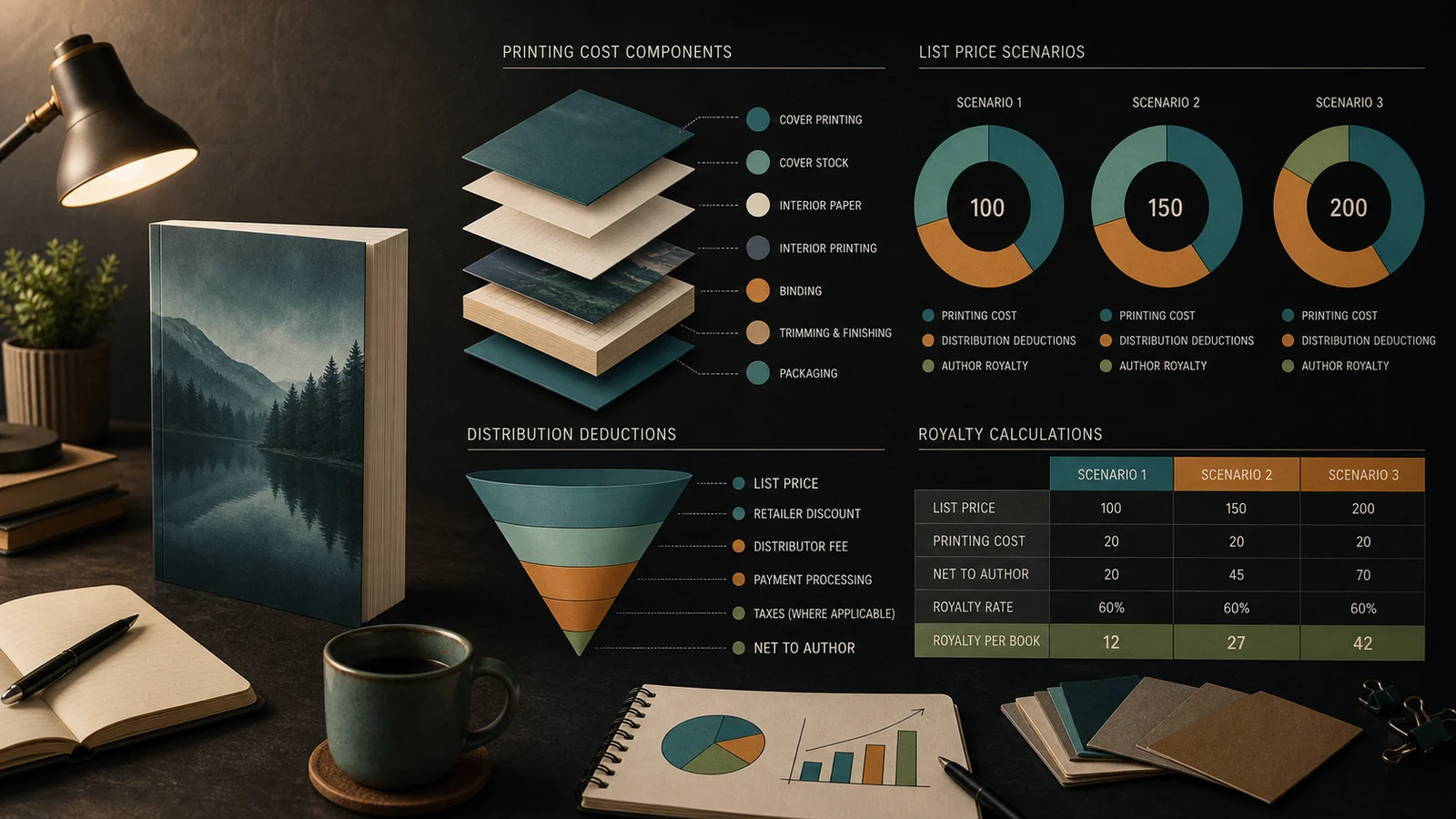
KDP print economics begin with one formula
Amazon KDP describes a print royalty as the applicable royalty rate multiplied by the tax-exclusive list price, minus printing cost. The exact inputs vary by marketplace, format, page count, ink, trim size, and distribution channel.
royalty = (royalty rate × tax-exclusive list price) − printing costPrint-on-demand means an author usually does not buy inventory in advance, but each sale must still absorb the book’s production cost before a royalty remains.
What changes the printing cost
- Paperback or hardcover format.
- Black ink or color interior.
- Page count and trim size.
- Marketplace in which the order is printed.
- Any minimum fixed cost plus a per-page component.
Do not reuse a calculation from a different edition. A paperback, hardcover, large-print edition, and color edition can have materially different economics even when the manuscript is similar.
Price thresholds can matter as much as print cost
KDP publishes marketplace-specific list-price thresholds for print royalty rates. Its US example shows a $9.99 list price receiving a 60% rate and $9.98 receiving 50%, before printing cost is deducted. That one-cent difference can therefore change the royalty more than one cent.
Standard and expanded distribution are different channels
KDP’s help pages describe standard Amazon distribution using a 50% or 60% print rate depending on price and marketplace, while Expanded Distribution uses 40%, with printing cost deducted in each case. Expanded Distribution can widen availability but does not guarantee that a bookstore or library will order the title.
Model each channel separately. A price that leaves an acceptable standard-distribution royalty may be too narrow under the expanded rate.
Build a pricing worksheet
| Field | Record |
|---|---|
| Edition | Format, trim, ink, page count, bleed |
| Marketplace | Currency, minimum list price, tax treatment |
| Channel | Amazon or Expanded Distribution |
| Economics | List price, rate, print cost, estimated royalty |
| Commercial goal | Target royalty, competitor range, discount headroom |
Run the official calculator at a low, target, and high price. Then order a proof and validate the physical product before optimizing solely for margin.
Payment timing is not sale timing
KDP’s royalty documentation explains that payments generally arrive after the month in which the sale was reported, with longer timing for Expanded Distribution. Returns, taxes, currency conversion, and payment thresholds can affect the amount or date. Treat the dashboard as a reporting system, not immediate cash flow.
For files and launch steps, continue with the KDP publishing guide; for organizing multiple titles, use the KDP series guide.
Frequently asked questions
KDP uses print-on-demand, so authors generally do not buy inventory upfront. Printing cost is deducted from the royalty on each print sale.
KDP states the basic formula as royalty rate multiplied by the tax-exclusive list price, minus printing cost. The applicable rate depends on marketplace, price, and distribution channel.
Yes. KDP publishes marketplace-specific thresholds; its US example shows $9.99 qualifying for 60% while $9.98 uses 50%, before print cost is deducted.
Sources and references
- Paperback printing costAmazon KDP · primary · Accessed 2026-08-20
- Paperback royaltyAmazon KDP · primary · Accessed 2026-08-20
- Paperback royalty rates and price thresholdsAmazon KDP · primary · Accessed 2026-08-20
- Printing cost and royalty calculatorAmazon KDP · primary · Accessed 2026-08-20